Jev by TypeSafe AI: fast decisions for software
How Jev and System One models turn context into typed decisions, what the launch benchmarks show, and where the limits remain.
What is Jev?
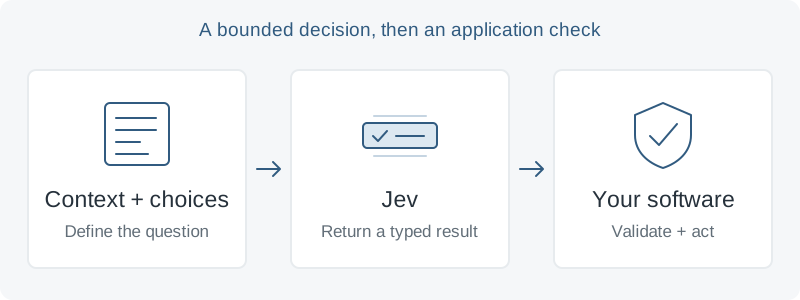
Jev is TypeSafe AI’s first System One model, announced on September 15, 2026. It takes context and narrowly defined questions, then returns decisions that an application can use: a category, a score, or the probability that a statement is true. TypeSafe launched it in early access. The announcement describes a new architecture, parallel sampling, and a training method called Reinforcement Learning for Calibrated Decisions (RLCD).
The interesting application is the judgment inside a workflow. A support system already knows how to assign a ticket; it needs help deciding which queue fits the message. Jev supplies that judgment, while ordinary code defines the available actions and handles what happens next.
How is it different from an LLM?
According to the System One documentation, Jev accepts text, including text arranged in JSON, and returns constrained decisions. It does not write explanations, code, or conversational replies. Independent questions can share the same context and be evaluated in parallel. That narrower job is central to the design.
LLMs can also produce schema-constrained outputs. A fair comparison therefore includes a properly configured LLM, as well as simpler classifiers or rules. The useful questions are whether Jev improves decision quality, uncertainty estimates, latency, and cost on your workload.
Three kinds of question
The API primitives define the answer space before inference:
- Choice: select from named options, such as billing, technical support, or other. Returns a choice, probabilities across the options, and confidence.
- Score: rate something against ordered, described levels. Returns a score and a probability distribution, plus confidence.
- Noul: estimate the probability that a yes/no condition holds. Its value runs from zero to one; it has no separate confidence field.
Ask one clear thing per question. If a decision depends on several factors, ask about them separately and combine the answers in code. Include an “other” option when a category list may be incomplete.
A small routing example
Imagine a ticket saying, “My receipt shows two charges.” Supply the message and relevant account context. A Choice question identifies its department; a separate Noul question checks whether the customer explicitly requests a refund. Those are different judgments: reporting a charge does not necessarily request a particular action.
This illustrative policy shows how an application might consume the department answer. It is not an SDK example, a measured result, or a recommended threshold:
const reviewThreshold = 0.9; // Validate on your own tickets.

if (
  department.choice === "other" ||
  department.confidence < reviewThreshold
) {
  queueForReview(ticket);
} else {
  assignToQueue(ticket, department.choice);
}
TypeSafe’s confidence documentation explains that Choice and Score confidence summarizes the shape of their probability distribution. It is not an independent verification of the answer. A confidence of 0.9 should not be read as a guaranteed 90% success rate for this ticket. Evaluate thresholds against labeled examples, the cost of mistakes, and how much work reaches review.
What the launch numbers establish
TypeSafe advertises gains of 193.6× in speed and 444.6× in cost from its workflow evaluations. These are vendor results for particular comparisons, not general guarantees. The announcement says they are likely near the upper end of practical gains.
The evaluation site covers four workflows: security incidents, agent traces, invoices, and customer service. Its reference labels come from the combined predictions of two large models, rather than independently established ground truth. That measures agreement with the chosen reference under the published setup. Repeating the comparison on your own labeled tasks is still necessary.
Where to be careful
TypeSafe’s “zero hallucinations” claim concerns guaranteed output structure. A valid category can still be the wrong category. The company’s Jev 1.13 limitations explicitly describe mistakes with arithmetic, date comparisons, indirect questions, distracting context, and adversarial input. Keep calculations and permissions in code; test hostile or ambiguous messages alongside normal ones.
As checked on September 20, 2026, the model reference lists jev-1.13.0, text-only input, and stronger performance in English. Test Arabic on representative messages. Pin a model version when tuning thresholds, because aliases can move.
A useful first trial is routing or passage classification in a RAG pipeline. Measure wrong decisions, cases sent for review, and end-to-end latency together. Fast classification helps only when the resulting workflow remains useful.
Read the primary sources
- Read the launch claims and their caveatsTypeSafe AI · September 15, 2026
- Define Choice, Score, and Noul questionsTypeSafe AI documentation
- Understand probabilities and confidenceTypeSafe AI documentation
- Inspect the workflow evaluation methodTypeSafe AI evaluations
- Check the documented failure modesJev 1.13 limitations
An introductory synthesis of TypeSafe AI’s announcement, documentation, and evaluations, with OpenAI documentation for the structured-output comparison. Reviewed September 20, 2026. The example and diagram are illustrative originals; performance claims are attributed to TypeSafe and were not independently reproduced for this note.